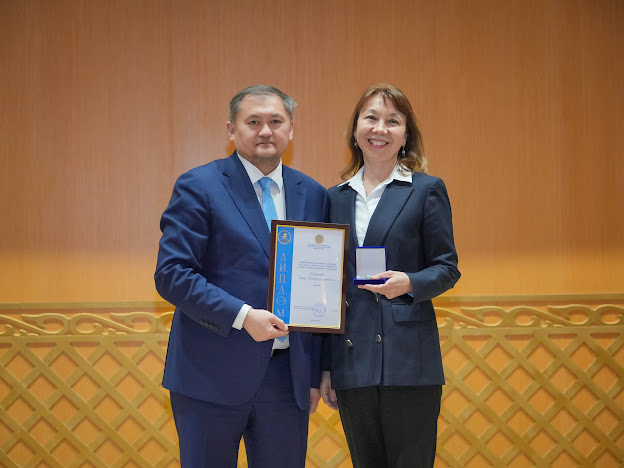
By Order of the Ministry of Science and Higher Education of the Republic of Kazakhstan dated 29 December 2025, Associate Professor Dina Sharipova has been awarded a prestigious state prize for her significant contributions to science.
On 13 February, an official award ceremony honoring outstanding contributors to science and higher education was held in Almaty. Dr. Sharipova received the Sh. Ualikhanov Prize for Best Research in the Humanities for her study “Changing Well-Being in Central Asia: Evidence from Kazakhstan and Kyrgyzstan.”
The awards were presented by the Minister of Science and Higher Education of the Republic of Kazakhstan, Sayasat Nurbek, President of the National Academy of Sciences Akhylbek Kurishbayev, and Vice Minister Gulzat Kobenova.
The study examines changes in subjective well-being in Kazakhstan and Kyrgyzstan between 2011 and 2018, showing that economic growth alone does not guarantee higher life satisfaction. The findings highlight the importance of non-material factors such as civic engagement, social cohesion, and a sense of personal control.
The university community warmly congratulates Dr. Sharipova on this well-deserved recognition, expressing gratitude for her contribution to advancing science in Kazakhstan and wishing her continued success and new research achievements.
On 13 February, an official award ceremony honoring outstanding contributors to science and higher education was held in Almaty. Dr. Sharipova received the Sh. Ualikhanov Prize for Best Research in the Humanities for her study “Changing Well-Being in Central Asia: Evidence from Kazakhstan and Kyrgyzstan.”
The awards were presented by the Minister of Science and Higher Education of the Republic of Kazakhstan, Sayasat Nurbek, President of the National Academy of Sciences Akhylbek Kurishbayev, and Vice Minister Gulzat Kobenova.
The study examines changes in subjective well-being in Kazakhstan and Kyrgyzstan between 2011 and 2018, showing that economic growth alone does not guarantee higher life satisfaction. The findings highlight the importance of non-material factors such as civic engagement, social cohesion, and a sense of personal control.
The university community warmly congratulates Dr. Sharipova on this well-deserved recognition, expressing gratitude for her contribution to advancing science in Kazakhstan and wishing her continued success and new research achievements.